
WHS Audits in Construction: Culture, Not Just a Checkbox
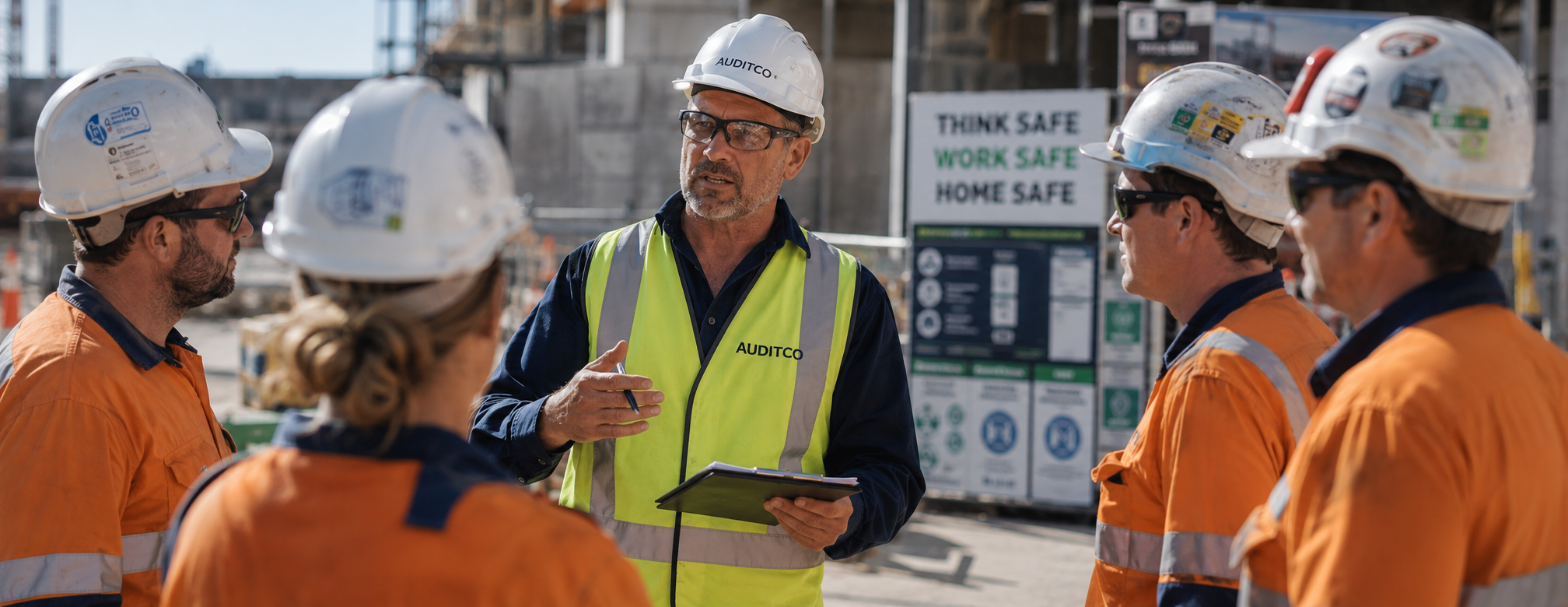
Every construction business in Australia has WHS obligations. Most have documentation to prove it. Far fewer have a safety culture that genuinely reflects what those documents say and that gap is where the real risk lives.
A WHS audit is not about finding a reason to issue a fine or mark a non-conformance on a form. Done well, it is a diagnostic tool that reveals the distance between your safety system on paper and your safety system in practice. That distance is usually larger than anyone expects, and it tends to be filled by assumptions, workarounds, and habits that have never been formally challenged.
What a WHS Audit Actually Examines
A thorough WHS audit in a construction context looks at three interconnected layers.
- The system: Does your WHS management system meet the requirements of the relevant legislation and applicable standards? Are your policies current, your procedures documented, your training records complete? Is your hazard and incident register being used?
- The implementation: Are the procedures being followed in the field? Is high-risk work being properly controlled? Are supervisors equipped to manage WHS, or are they so focused on program and cost that safety becomes reactive?
- The culture: Do workers feel safe raising concerns? Is near-miss reporting seen as valuable or as a nuisance? When safety and schedule conflict, which one wins? The answers to these questions are harder to document than a SWMS register, but they are the most accurate predictor of whether your site will have a serious incident.
Culture Is an Audit Finding, Not a Soft Topic
There is a persistent tendency in the industry to treat safety culture as too intangible to audit. This is a mistake. Auditors with genuine construction experience know how to identify cultural indicators, the way supervisors respond to questions, the state of the hazard board, the proportion of workers who can clearly articulate the risks of their specific task. None of this requires a psychology degree. It requires an auditor who has seen what good looks like and can identify what falls short of it.
When a WHS audit surfaces cultural findings, the response needs to go beyond updating a procedure. It requires leadership commitment, visible follow-through, and often a reconsideration of how safety performance is measured and rewarded at site level.
Proactive vs Reactive: The Cost Difference
The financial case for proactive WHS auditing in construction is not complicated. A serious injury costs a construction business far more than an audit in workers’ compensation, project delays, investigation time, potential prosecution, and the long-term impact on the people involved. An audit that identifies a systemic gap before an incident occurs is not an overhead. It is risk management with a very clear return.
AuditCo’s WHS audits are delivered by experienced safety professionals who understand construction operations and speak the language of site teams. Our findings are practical, prioritised, and designed to be acted on, not filed away.
Talk to us about what a WHS audit program could look like for your business. Explore AuditCo’s WHS audit services
Related Posts
Subcontractor Compliance: Who’s Responsible When Things Go Wrong?
Pre-qualification tells you what a subcontractor looked like on paper before they started. It says…

ISO 9001 for Logistics Providers: What Quality Management Means When Your Product Is Service
ISO 9001 was written with manufacturing in mind — product conformance, production processes, inspection and…
QA/QC Inspections: Catching Defects Before They Become Defect Claims
QA/QC inspections help construction teams identify defects and non-conformances before they become costly rectification works,…