
ISO 9001 in Manufacturing: What Certification Actually Involves Day to Day
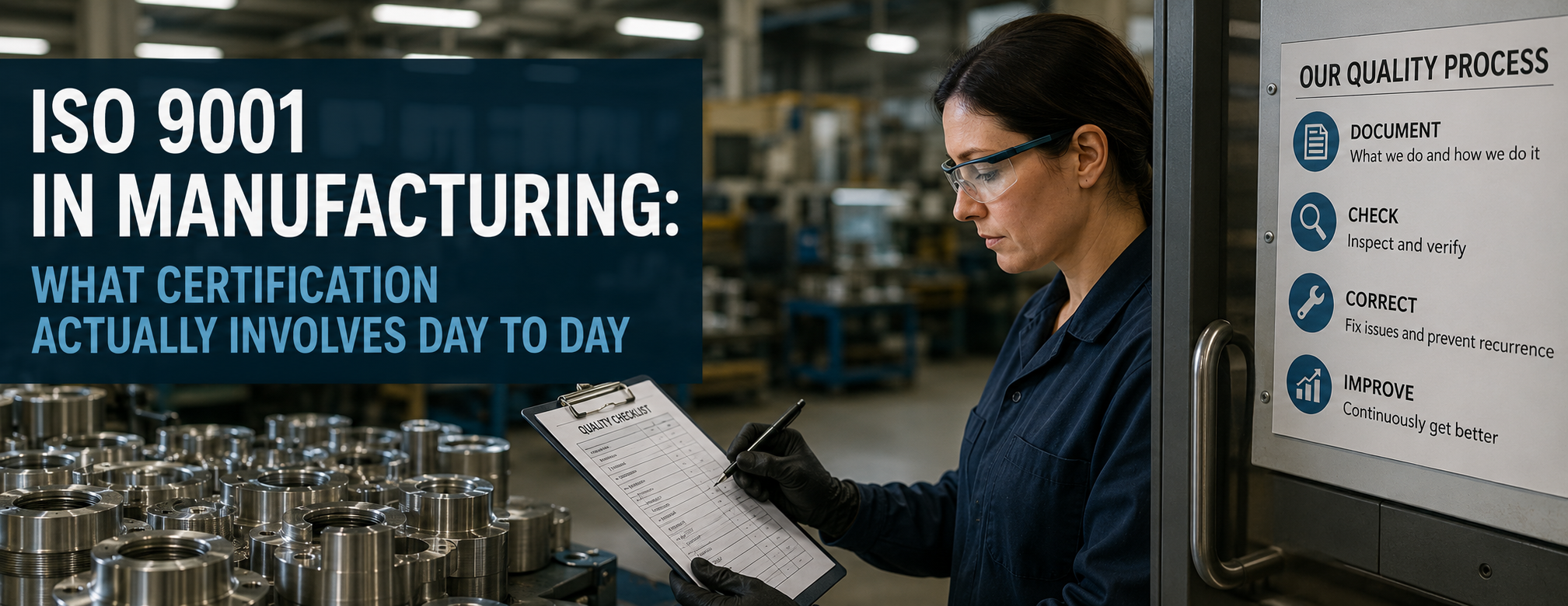
ISO 9001 certification is often described in terms of what it requires you to produce, a quality policy, a quality manual, documented procedures, an internal audit program. This description is accurate but incomplete. It captures the documentation dimension of the standard without capturing what certification actually demands from a manufacturing organisation on a daily basis.
The distinction matters, because manufacturers who pursue ISO 9001 as a documentation exercise, building the paper trail without genuinely changing how quality is managed, almost always find that the certificate is harder to maintain than expected, and less commercially valuable than anticipated. The manufacturers who get the most from certification are those who understand what the standard is actually asking them to do.
The Three Things ISO 9001 Really Requires
- First, it requires that your processes are defined and followed. Not documented and filed, documented and used. The standard requires that you have identified the processes that affect product quality, that you have defined how those processes should operate, and that you have mechanisms to verify that they are operating as defined. In a manufacturing context, this means production processes, inspection and test processes, material handling processes, and the management processes that govern them.
- Second, it requires that when things go wrong, you understand why. Nonconformance management under ISO 9001 is not just about quarantining and dispositioning non-conforming product, it is about understanding the root cause of the nonconformance and implementing a corrective action that addresses that cause. Corrective actions that say “re-train operator” without examining why the process allowed the error to occur in the first place do not satisfy this requirement, and experienced certification auditors will identify this quickly.
- Third, it requires that you improve. Continual improvement is not a phrase in the standard, it is a requirement. Your quality management system needs to be generating improvement in process performance over time, and your management review process needs to be examining the evidence and driving action. A QMS that is in the same state year after year is not a conforming quality management system.
What Surveillance Audits Actually Look For
Once certified, manufacturers undergo annual surveillance audits. These are not a repeat of the certification audit, they focus on whether the system is being maintained and whether the improvement commitment is genuine. Auditors will look at your nonconformance register and ask what the trend has been. They will look at your internal audit findings and ask what corrective actions were implemented. They will review your management review minutes and ask what decisions were made.
Manufacturers who treat certification as a destination, achieved and then maintained, find surveillance audits uncomfortable. Those who treat it as a management framework find them straightforward.
AuditCo provides ISO 9001 certification audits and ongoing surveillance audit services for Australian manufacturers. Talk to us about what certification involves for your specific operations.
Explore AuditCo’s ISO 9001 audit services →
Related Posts

What the Australian Notifiable Data Breaches Scheme Actually Requires of Your Organisation
The NDB scheme has real teeth — and most organisations don't fully understand what it…

ISO 27001: Why Information Security Certification Has Gone From Nice-to-Have to Non-Negotiable
ISO 27001 is not a cybersecurity tool. It is a management system standard that provides…
ISO 27001 – Why It’s Crucial for Modern Organisations
In today’s hyper-connected world, data is one of your organisation’s most valuable assets. With the…