
WH&S Risk Management in Early Learning Centres: Governance, Compliance and the Duty of Care Imperative
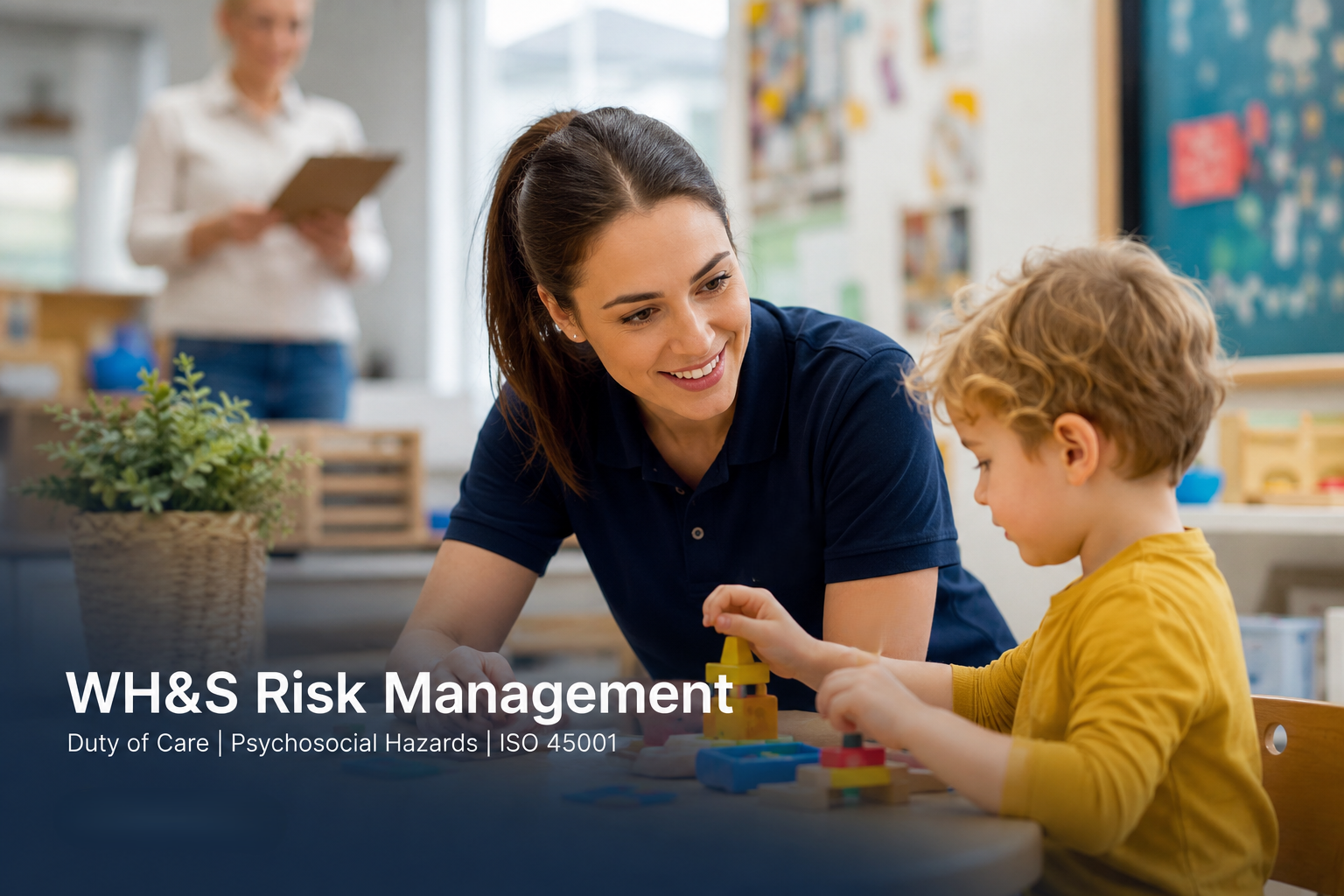
Early learning centres are complex workplaces. Educators sustain low level postures for hours. They lift and carry children repeatedly. They manage intense interpersonal dynamics and absorb significant emotional labour. The psychosocial load, including role overload, staff shortages, and compounding regulatory pressure, is well documented and serious. In addition, the legal consequences of WH&S failures in this sector are real.
Under the Work Health and Safety Act 2011, persons conducting a business or undertaking (PCBUs) have a primary duty of care to ensure, so far as is reasonably practicable, that workers are not exposed to health and safety risks. That duty is not discharged by having a policy. It requires active, systematic, and documented risk management.
The Legislative Framework
Key obligations for early learning operators include the primary duty of care under section 19, which requires PCBUs to ensure worker health and safety, both physical and psychological, so far as is reasonably practicable. There is a duty to consult under sections 47 to 49, requiring PCBUs to consult workers on matters affecting their health and safety, including proposed changes to risk exposure. There is a duty to manage risks under sections 17 and 18, meaning risks must be eliminated where possible or minimised using the hierarchy of controls. There is a duty to notify incidents under sections 35 to 38, meaning notifiable incidents must be reported to the relevant regulator as soon as possible. And there is a record keeping obligation, meaning WH&S records including risk assessments, incident reports, training records, and consultation documentation must be maintained and available for inspection.
The High-Risk Hazard Areas
Manual handling and musculoskeletal risk is the leading cause of injury in early learning workplaces. Repetitive lifting, sustained low level postures, cot management, and nappy changing all place significant load on the spine, shoulders, and knees. A compliant manual handling risk assessment identifies specific tasks, assesses risk levels, and specifies controls such as equipment, work design changes, and task rotation, not just training.
Psycho-social hazards are addressed explicitly in Safe Work Australia’s Code of Practice on Managing Psycho-social Hazards at Work (2022): psychological risks must be managed with the same rigour as physical ones. In early learning settings, the most significant psycho-social hazards include high job demands with limited control, role overload in understaffed environments, exposure to traumatic or distressing events involving children or families, workplace conflict and poor interpersonal relationships, and lack of organisational support or recognition. Access to an Employee Assistance Program is not a psycho-social risk control. It’s a support resource. PCBUs must identify hazards, assess risks, and implement actual controls.
Noise exposure is a real issue in early learning environments, which routinely exceed safe noise levels during peak activity periods. Sustained exposure above 85 dB(A) over eight hours creates risk of noise induced hearing loss. Centres should assess noise levels in high activity areas and implement controls where warranted.
Slip, trip and fall hazards arise from wet play areas, outdoor surfaces, and the physical unpredictability of environments with young children, all of which create elevated risk for educators. Regular environmental risk assessments should identify and address these hazards systematically.
The Hierarchy of Controls
In order of effectiveness: elimination removes the hazard entirely, for example height adjustable nappy stations remove the ergonomic hazard of fixed low-level units. Substitution replaces the hazard with a lesser risk. Isolation separates the hazard from workers, for example acoustic barriers in high noise areas. Engineering controls are physical modifications to the environment, such as non-slip surfaces and equipment guards. Administrative controls involve changes to work systems, such as task rotation, staffing ratios, and training. Personal protective equipment is the lowest order control, used where other measures can’t adequately manage the risk.
Documentation and Governance
A compliant WH&S management system requires a WH&S policy endorsed by the governing body, a hazard register covering all identified hazards with risk ratings, controls, and review dates, risk assessment records for all significant tasks and environments, incident and near miss reports with corrective action tracking, worker consultation records showing how feedback influenced risk decisions, and training records covering induction, task specific training, and required certifications.
How AuditCo Can Help
Most WH&S failures in this sector aren’t failures of intent. They’re failures of system: a manual handling risk that’s never been formally assessed, a psychosocial policy that was never built from an actual hazard identification process, a hazard register that hasn’t been reviewed since it was created. AuditCo provides independent WH&S compliance audits for early learning operators, covering manual handling risk assessments, psychosocial hazard assessments aligned with Safe Work Australia’s 2022 Code, and full documentation and governance reviews. We help you move from a policy that exists on paper to a system that would hold up under regulator scrutiny.
If your WH&S documentation hasn’t been independently reviewed recently, get in touch to arrange an audit.
Related Posts

HACCP in Practice: The Difference Between a Plan That Works and One That Sits in a Binder
Having a HACCP plan and having a working HACCP plan are two different things. This…
What Construction Site Safety Inspections Actually Cover and Why They Matter
A real site safety inspection goes well beyond PPE checks. Here's what it covers, why…

Understanding Playground Inspection Standards in Australia
Children learn through movement. Climbing, swinging, balancing, and jumping. Outdoor play is where physical confidence,…